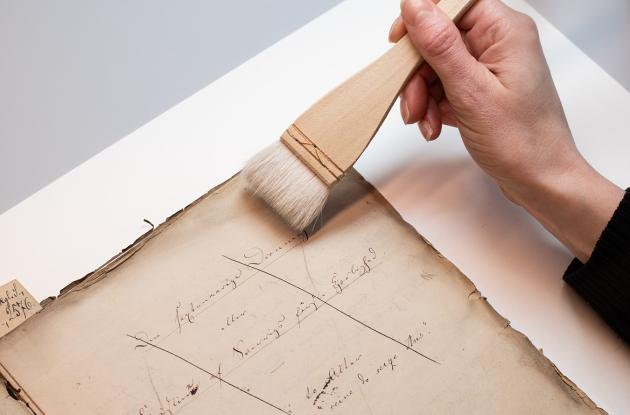
From manuscripts to digital cultural heritage
From 2025 to 2027, the library will digitise all of HC Andersen's manuscripts and letters. The fairy tale manuscripts were digitised in a previous project, and now the rest is being digitised aswell!
Digitisation is about more than creating digital copies of documents. It is a comprehensive process where conservators, photographers, librarians, historians, digital collections specialists and communicators work together to preserve, describe and make the materials accessible for the future.
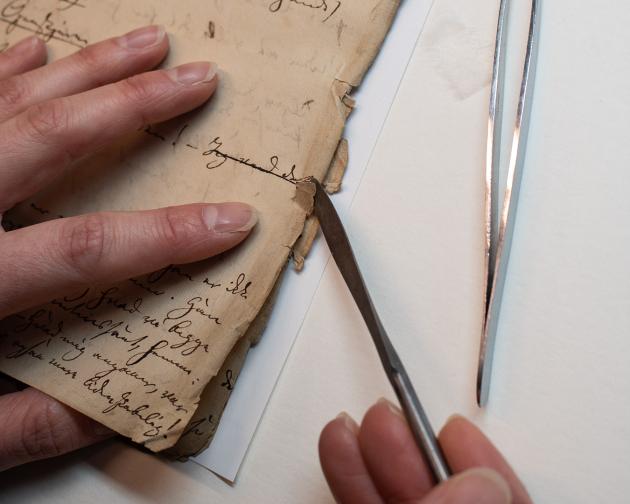
Photo: Det Kgl. Bibliotek
The project ensures that Hans Christian Andersen's manuscripts and letters are preserved and can be explored by researchers, educators, students and anyone interested in his life and works. At the same time, the project examines how new technologies can provide new insights into the historical materials.
Below, you can get a behind-the-scenes look at the digitisation process.
Preserving Hans Christian Andersen in the collections
In the first part of the digitisation flow, conservators review all materials to ensure they can be handled during the photography process and that the digital images are of the highest quality possible. Materials are preserved as needed - for example, tears in the fragile paper or damage from iron gall ink, which can degrade the paper over time. There may also be surface dirt that needs to be removed, or curled pages that need to be straightened in order to make the text easier to read.
The Hans Christian Andersen collections at Royal Danish Library have been conserved and repackaged on an ongoing basis over many years. In the project Hans Christian Andersen's Manuscripts and Letters Online: World Heritage for All, however, all sub-collections are systematically reviewed as part of the preparations for digitisation.
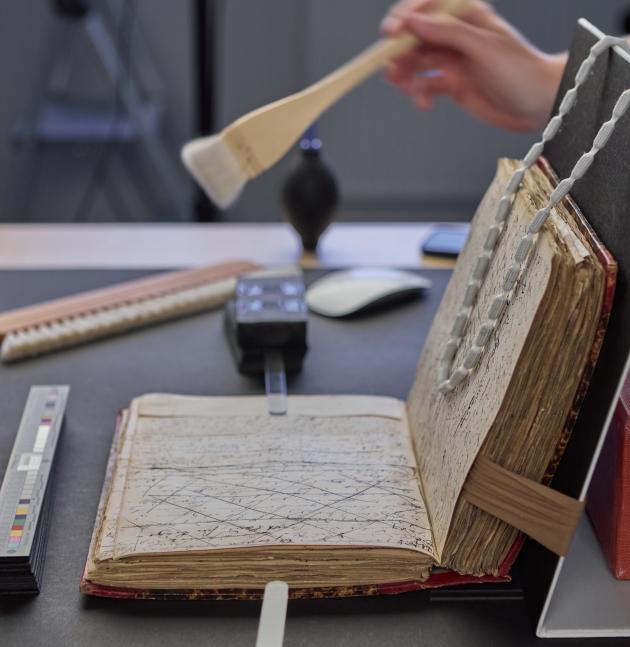
Photo: Det Kgl. Bibliotek
Behind the camera: Digitisation
When our library digitises Hans Christian Andersen's manuscripts and letters, we take photographs with high-resolution cameras. We use this method rather than scanning the material. The method is gentler on the, often fragile, originals and makes it possible to reproduce the small details in the paper, ink and handwriting. The process is called retro-digitisation, converting analog cultural heritage materials into digital representations.
During the photography stage, we use special equipment such as weights, plexiglass rods and elastic materials to stabilise the fragile documents. This is especially important because Hans Christian Andersen's manuscripts and letters often contain glued patches, seams and folds. This also means that a single page might require multiple snapshots.
Our photographers use reference rulers and colour targets to check exposure, LAB values and colour space, ensuring high colour accuracy and providing documentation so that the digital reproductions closely match the originals. Each photograph is assigned technical metadata on the camera, lens, exposure and colour profile, documenting the image and ensuring a consistent, traceable digitisation process.
Digitisation equipment/technical setup
Phase One XF medium-format camera with an IQ4 150MP digital back and a Schneider Kreuznach 120mm LS f/4.0 AF Macro Blue Line lens
1 × Phase One IXH 150MP medium-format camera with a Phase One SK 72mm MKII iXH-RS lens
Software: Capture One CH (Cultural Heritage Edition)
Lighting: Broncolor and Godox flash
Camera stand from Kaiser and Cambo
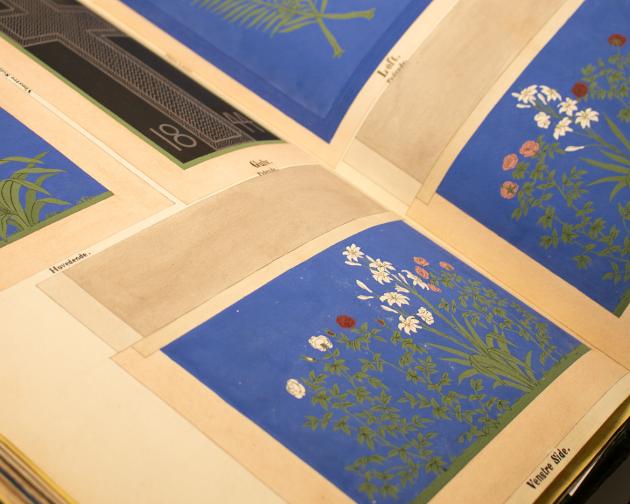
Photo: Det Kgl. Bibliotek
Cataloguing in the library system
Before we are digitising Hans Christian Andersen's manuscripts and letters, we review thousands of archival documents to add elaborate metadata. Our research librarians obtain metadata information through catalogues and research literature. In some cases, we create entirely new manuscript descriptions based on the original works. This ensures that each manuscript or letter can be assigned metadata at work level. Which in turn will make it easier for future users and researchers to find the material.
Every manuscript - from long novels to the smallest of notes - are continuously made available in the library system and the library's digital collections, both as classic catalogue entries and in digital form. When the project is completed, the entire collection will be freely available online in high quality and with searchable metadata.
Digital preservation policy
You can read more about Royal Danish Library's policy for digital preservation. The policy describes the overall framework for the library's work with preserving our collections of digital cultural heritage material.
New digital cultural heritage
After the many thousands of pages of letters and manuscripts have been digitised in high resolution, we are securing the digital files so that they can be preserved and used in the future. We store the files in formats suitable for long-term digital preservation, following internationally recognised standards for preservation.
Copies of the files are stored in independent geographical, technical and organisational environments to protect us from losing them. In this way, we ensure that the digitisations of Hans Christian Andersen's letters and manuscripts can be preserved and used for many years to come.
New technologies and new discoveries
The project Hans Christian Andersen's Manuscripts and Letters Online: World Heritage for All comprises three pilot projects: XRF and MSI imaging analysis, and AI transcription.
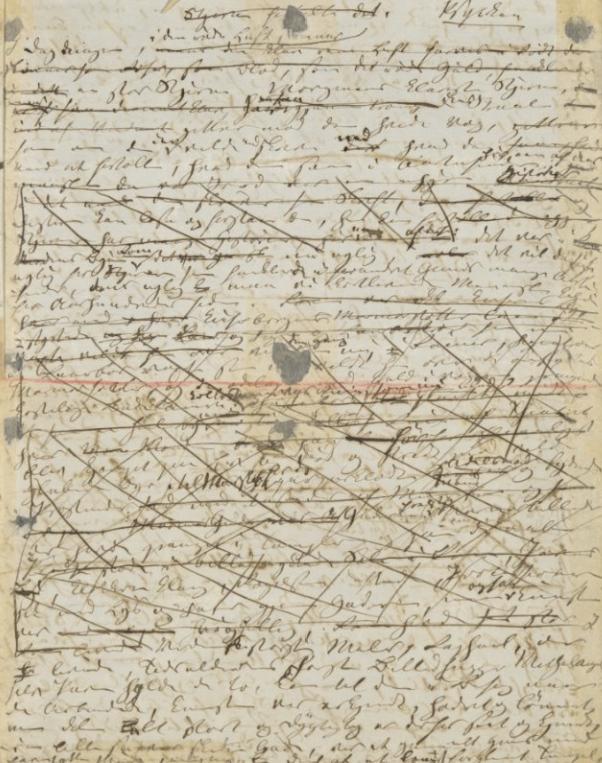
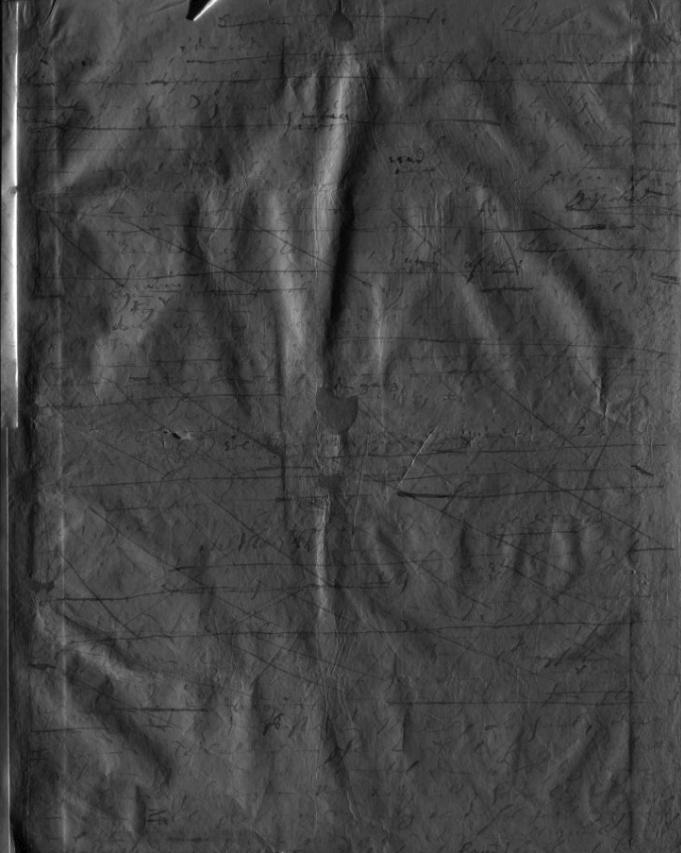
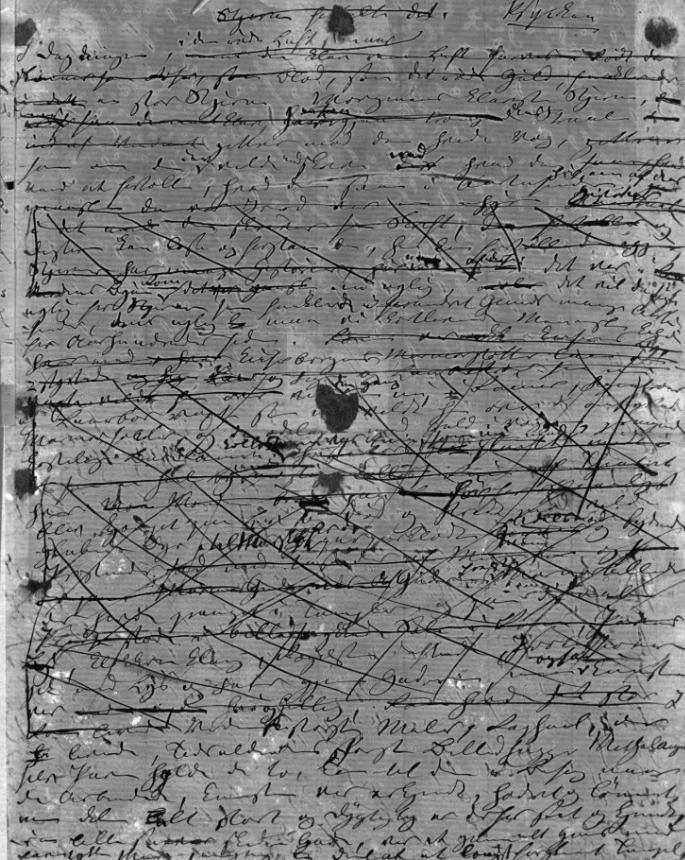
XRF (X-ray fluorescence) is used to analyse iron gall ink in Hans Christian Andersen’s almanacs and diaries. The ink was made using vitriol, a mineral substance with a different elemental composition depending on its origin. As a result, each type of ink has a unique ‘fingerprint’, which we examine using XRF to investigate whether the method can be used to date manuscripts that Andersen himself did not date.
MSI (multispectral digitisation) photographs manuscripts in different wavelength ranges of electromagnetic radiation, such as ultraviolet (UV), visible light, and infrared (IR). Paper, ink, and pigments have unique spectral signatures and absorb, reflect, and emit radiation differently depending on the wavelength, which allows MSI to highlight details that are not visible to the human eye.
MSI provides spatial and optical information, while XRF shows the elemental composition of the materials. Together, they provide new knowledge about the manuscripts' materials, origin, use and state of preservation.
The AI pilot project develops a language model for transcribing HC Andersen's manuscripts and letters. We train the model on existing transcriptions and then test it on unpublished manuscripts. A selection of the transcriptions will be published after a quality check in the library system.
Digitisation of Hans Christian Andersen's fairy tales
What about the fairy tales? All of Hans Christian Andersen's manuscripts for fairy tales and stories have already been digitised in our collections. The fairy tales were digitised in 2020-2022 through a collaboration between Royal Danish Library and The Hans Christian Andersen Centre at University of Southern Denmark. The digitised fairy tales can now be viewed online on both institutions' websites.
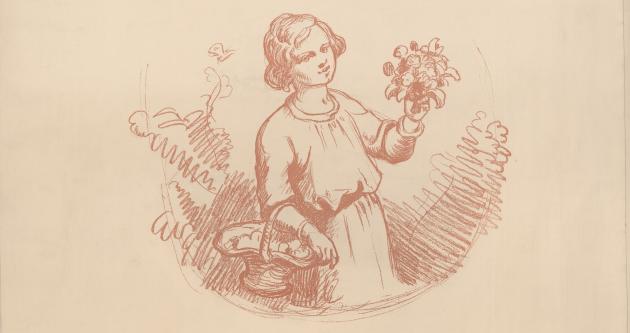
Photo: Thomas Vilhelm Pedersen (1820-1859)
Support of the digitalisation
Royal Danish Library has received a generous donation of DKK 5.8 million from the A.P. Møller Fund. The fund support will help with the digitisation of our extensive collection of lesser-known original works and letters from Hans Christian Andersen.
We are very grateful to have received this support from the A.P. Møller Fund. Hans Christian Andersen's writings and fantastic fairy tales mean a lot to the Danish people – we get to read them aloud as children, learn about them in school and so on. The fact that Royal Danish Library now can bring Hans Christian Andersen's manuscripts and letters to a wider audience, is therefore also of great importance for how we can further communicate our cultural heritage. We look forward to sharing Hans Christian Andersen's treasures with the public.
The support from the A.P. Møller Fund makes it possible to explore these treasure troves and make them accessible to everyone.
Project: Hans Christian Andersen's Manuscripts and Letters Online: World Heritage for All
Period: October 2025 – December 2027
Project manager: Anja Meier Sandreid, amsa@kb.dk
Content: Conservation review and conservation as needed, metadata and high-quality digitisation of Hans Christian Andersen's manuscripts and letters. The project also includes dissemination, teaching and testing of new technologies for AI transcription and advanced image analysis with MSI and XRF.
Scope: More than 50,000 pages of manuscripts for Hans Christian Andersen's dramas, poems, novels, diaries, almanacs and correspondence between Hans Christian Andersen and others.
Financing: The project is possible thanks to funding of DKK 5.8 million from the A.P. Møller Fund.
Purpose: To preserve Hans Chrisitan Andersen's letters and manuscripts for the future and make them digitally accessible and communicate their content to researchers, teachers, students, libraries and a broad audience.
Royal Danish Library has the world's largest Hans Christian Andersen collection. The library's collections also include the original printed editions of all of Hans Christian Andersen's works, but they are not part of this digitisation and dissemination project. Hans Christian Andersen's manuscripts and letters at Royal Danish Library were included in UNESCO's Memory of the World Register of the World's Written Cultural Heritage in 1997.
Go exploring
In 2025-2027 we will digitise all of Hans Chrisitan Andersen's manuscripts and letters. You can explore Royal Danish Library's digital collections online and see how far we have come.