
From Hans Christian Andersen’s Own Hand
Explore Hans Christian Andersen's original manuscripts, letters, diaries and other materials in Royal Danish Library's collections.
Hans Christian Andersen's manuscripts, letters, diaries and other materials are preserved in the collections of Royal Danish Library. These materials provide insight into both his work as an author and the life behind his writing.
The collections contain drafts and manuscripts for fairy tales, dramas, novels, poems and travel books as well as personal notes, almanacs and thousands of letters. The letters were both written by Hans Christian Andersen and sent to him, offering insight into his extensive network in Denmark and abroad.

Photo: H. C. Andersen (1805-1875)
The collections also contain photographs of Hans Christian Andersen as well as paper cut-outs, picture books, drawings and other creative works from his artistic career.
Novels
Hans Christian Andersen became internationally known already in his own lifetime - first, for his novels and later for his fairy tales too. When Andersen wrote his first novel The Improvisatore, the novel genre was not yet established in Denmark. The novel is based on his first major trip to Italy in 1833–1834 and was an important breakthrough for his writing.
Hans Christian Andersen wrote six novels: The Improvisatore (1835), O.T. (1836), Only a Fiddler (1837), The Two Baronesses (1848), To Be, or Not to Be (1857) and Lucky Peer (1870). Andersen also began novels that were never completed, including the draft of The Dwarf of Christian II.
The novels showcase Hans Christian Andersen’s work with different narrative forms and depictions of human life, identity and development. Through his novels, he explored the Bildungsroman, the contemporary novel and the novel of defeat, as well as the conflicts faced by outsiders and modern human beings.
Royal Danish Library’s collections contain a large number of manuscripts related to Hans Christian Andersen’s novels. Those that have already been digitised can be found here.
Poems and Lyric Poetry
Hans Christian Andersen wrote poems from his youth until shortly before his death. His poetry ranges from humor and satire to poems about nature, love, faith, and existential questions.
In 1830, "The Dying Child” and “The Mother with the Child” were, among others, published in his work Poems. This was followed by Phantasies and Sketches (1831), The Twelve Months of the Year, Drawn with Ink and Pen (1833), Collected Poems (1833) and Ahasuerus: A Mystery (1847), among others. “How Fresh and Vast the Forest” was written for Ole Lukøie (1850), while “In the Jura Mountains” and “In Neuchâtel" appear in a travel letter from 1867. From the 1830s onwards, Andersen also wrote occasional poems for birthdays and funerals.
Day by day everything becomes more and more poetry for me; poetry enters my life, and it seems to me that life itself is a great strange poetic poem.
Several of Hans Christian Andersen's poems became well-known songs, including The Mother with Child ("There, where the road bends..."), Denmark, my Fatherland ("In Denmark I was born, there is where I belong") and Jutland ("Jutland between two seas...").
Among the materials in the library's collections are manuscripts from all of Hans Christian Andersen's lyrical writings. Some of the drafts and manuscripts for poetry have been digitised and can be found here.
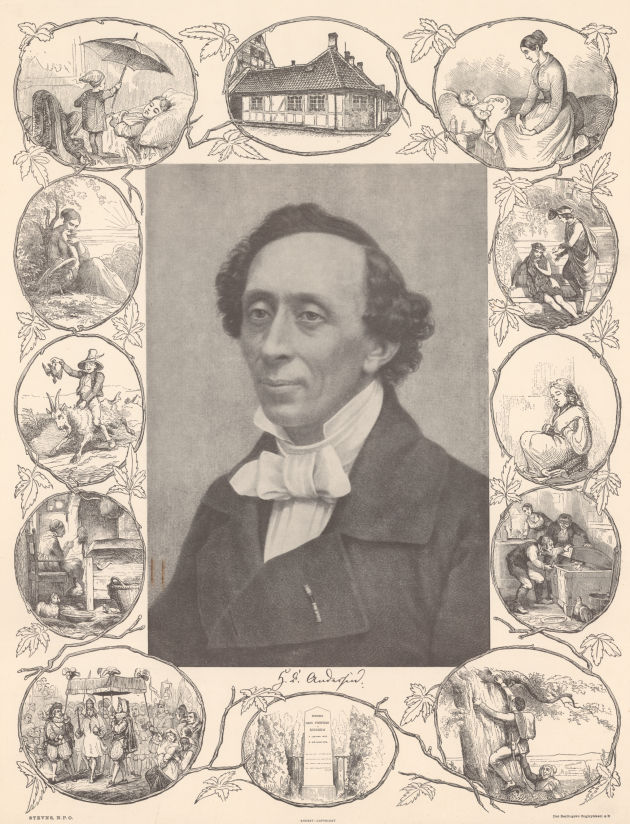
Photo: Mindeblad fra Berlingske Bogtrykkeri
Fairy Tales
Hans Christian Andersen was quick to begin working with the fairy tale form. His first attempts were The Diving Bell (1827), The Dead Man (1830) and The Tallow Candle. With Fairy Tales, Told for Children, which was published in booklets from 1835, his special fairy tale style found its form.
From handwriting to digital cultural heritage
Royal Danish Library's collections contain several of the manuscripts for Hans Christian Andersen's fairy tales and stories, including both drafts and fair copies. The manuscripts for the fairy tales have been digitised previously and can be viewed online.
In the 1830s and 1840s, Andersen wrote some of his best-known fairy tales, including The Lighter, The Little Mermaid, Thumbelina, The Swineherd, The Princess and the Pea, The Emperor's New Clothes, The Ugly Duckling and The Shepherdess and the Chimney Sweep. Later came the collections New Fairy Tales (1843–1848), Stories (1852–1853) and New Fairy Tales and Stories (1858–1872).
Travel Reports
Hans Christian Andersen's desire to travel was always part of his life. Andersen kept a diary on many of his journeys to capture material later used as travelogues.
Hans Christian Andersen's travel writing comprises five major travel books: Shadow Pictures of a Journey to the Harz Mountains and Saxon Switzerland etc. etc. in the Summer of 1831 (1831), A Poet's Bazaar (1842), In Sweden (1851), In Spain (1863) and A Visit to Portugal in 1866 (1868).
In his travel reports, Andersen combines personal experiences with poems, descriptions of nature, cultural-historical observations and narrative pieces. His travels inspired him to depict people, landscapes and the contemporary world and became an important source of his writing.
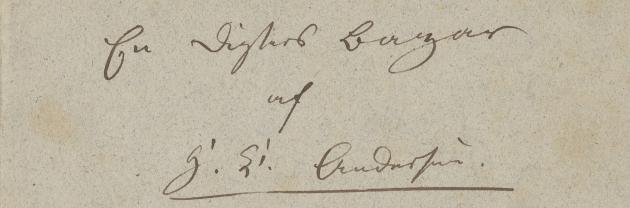
Photo: H. C. Andersen (1805-1875)
In addition to the actual travelouges, Andersen wrote many other texts about his travels at home and abroad, including "Silkeborg" (1853), "Skagen" (1859) and "A Visit to Charles Dickens in the Summer of 1857" (1860). Andersen's travels acted both a source of new experiences and an important part of his artistic development.
The travels left behind extensive material in Royal Danish Library's collections, including diaries, manuscripts for travel reports and other records from Hans Christian Andersen's travels.

Photo: Hjalmar Berth (1868-1950)
Dramas and Plays
The theatre played an important role in the life and writings of Hans Christian Andersen. His stage interest began in his childhood in Odense, where he saw theatrical performances as a child and was given a supernumerary part in the lyrical fairy-tale opera Cendrillon (Cinderella) when the Royal Danish Theatre visited the town.
As an author, Andersen wrote for the stage throughout his life, producing dramas, musical plays, fairy-tale comedies, opera librettos and light comedies. Among his dramatic works are Agnete and the Merman (1833), The Feast at Kenilworth (1836), The Invisible Man on Sprogø (1839), The Mulatto (1840) and Little Kirsten (1846). Later, he wrote other works such as More than Pearls and Gold (1849), Ole Lukøie (1850) and The Elder-Tree Mother (1851) for the newly established Casino Theatre.
In several of his dramatic works, Andersen collaborated with leading composers of the time, including J.P.E. Hartmann, Niels W. Gade and C.E.F. Weyse.

Photo: H. C. Andersen (1805-1875)
Several of Andersen's dramatic works are preserved as manuscripts at our library.
Accounts of his own Life
Hans Christian Andersen wrote several stories about his own life. The first was The Book of Life (1832), which describes his life up to his adolescence and was not rediscovered and published until 1926. In The Fairy Tale of My Life Without Poetry (1847), Andersen recounted his development as an artist and the journey from a difficult beginning to international recognition.
The two-volume work My Life's Fairy Tales can be regarded as Andersen's true autobiography. The first volume was published in 1855 and depicts his life from childhood up to the age of 50, while the second volume, published posthumously in 1877, covers the following years. The Fairy Tale of My Life was written for the first Danish edition of Andersen's Collected Works and describes the hardships he experienced in Denmark and the recognition he received abroad.
The autobiographies are an important part of the materials that reveal Hans Christian Andersen's own account about his life.
Paper Collages
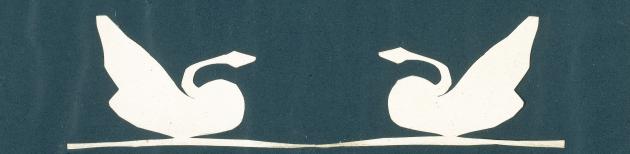
Photo: H. C. Andersen (1805-1875)
Hans Christian Andersen worked with more than only words; also paper, scissors and pictures. He created a large number of paper cutouts, picture books, drawings and collages.
Using simple and often rough cuts, Andersen created paper cutouts of elves, trolls, witches, goblins, imaginative figures and strange castles. The motifs were often rooted in the popular world of legends and fairy tales that had been an important part of his childhood.
In his picture books, Andersen combined pictures, clippings and short texts to create personal stories for family and friends. He also created colourful and complex collages, bringing together different materials such as clippings, cards, stamps and other small objects to form new pictures.
Royal Danish Library holds several of Andersen’s picture books, as well as some of his paper cut-outs.
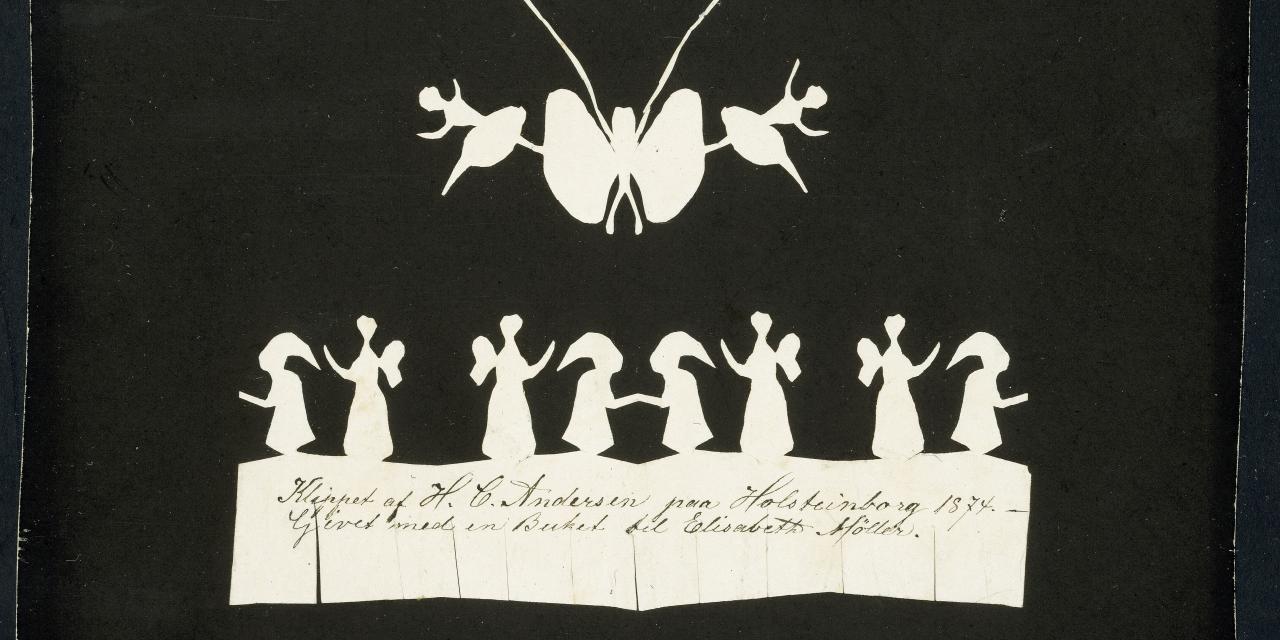
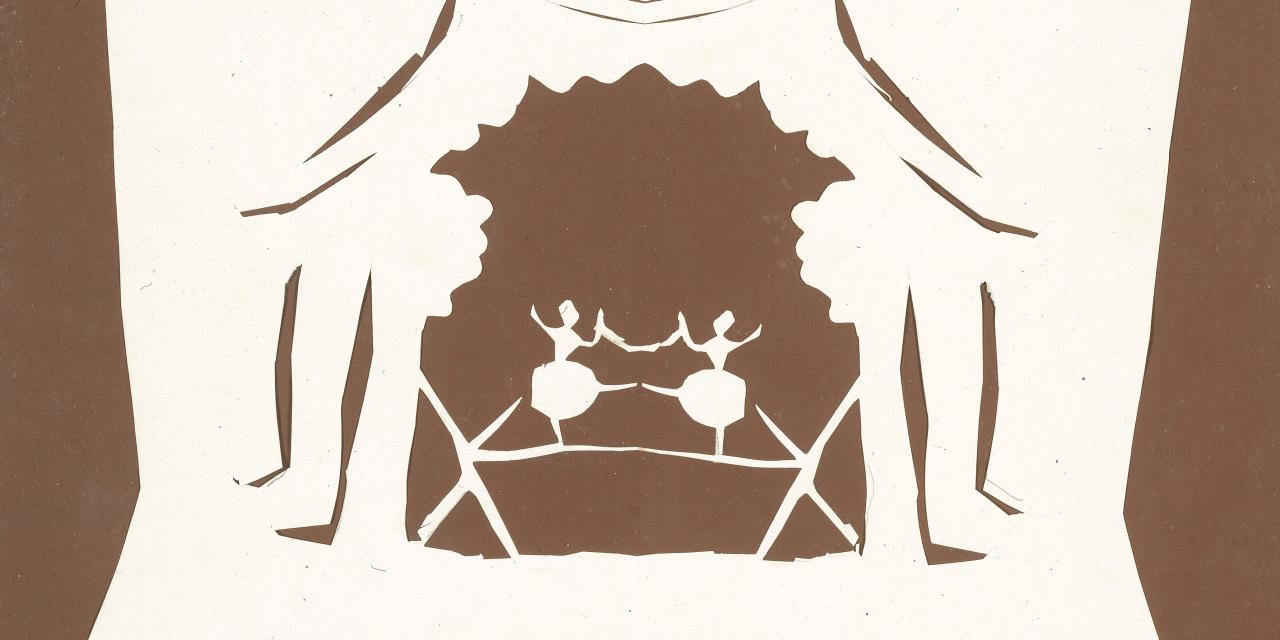
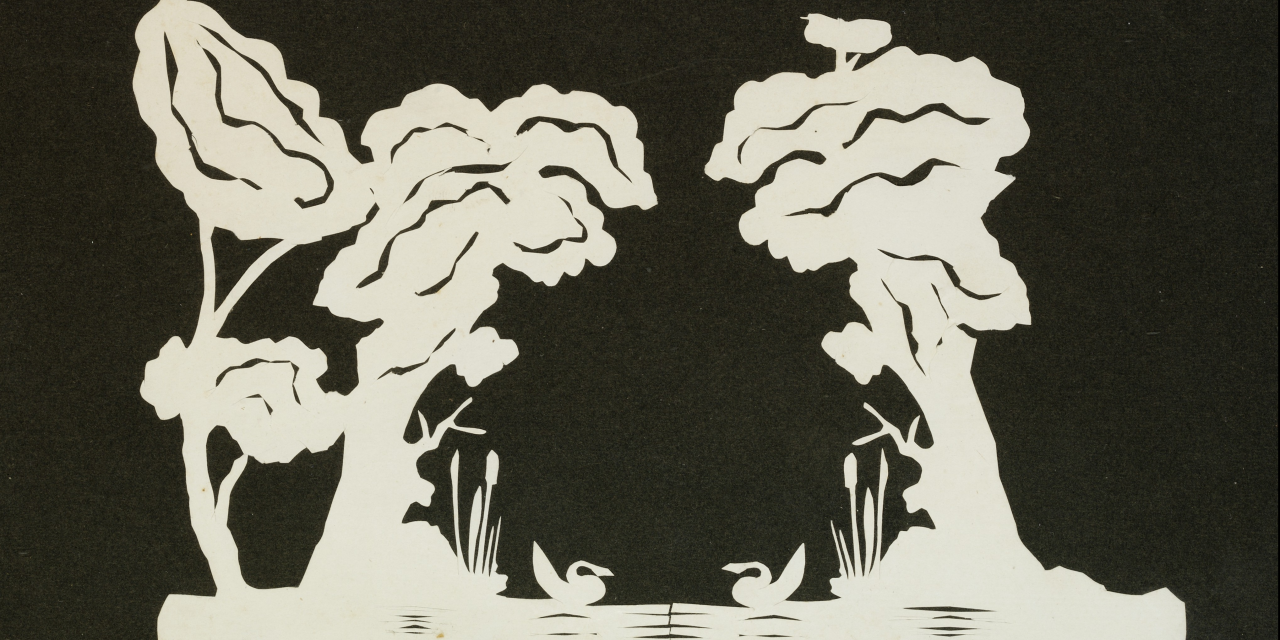
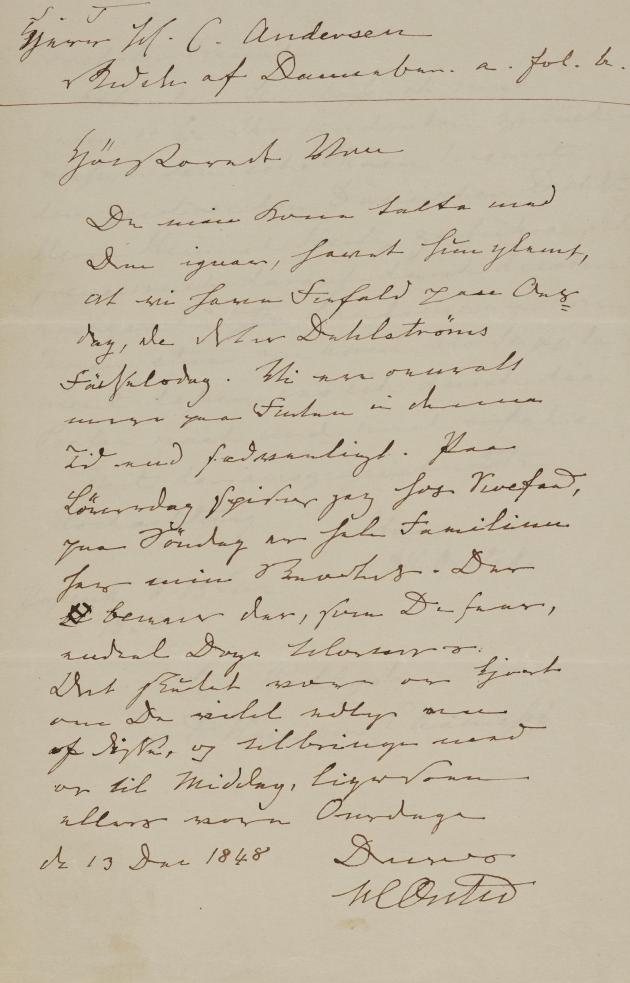
Photo: H.C. Ørsted (1777-1851)
Letters
Throughout his life, Hans Chrisitan Andersen wrote a large number of letters to people in Denmark and abroad and at the same time received letters from his large network.
The letters reveal his relationships, travels, work and daily life. Among the correspondence are connections to many famous people of the time, but also to family, friends and acquaintances.
Royal Danish Library's collections contain thousands of letters written by and to Andersen.
Diaries and Almanacs
Hans Christian Andersen's diaries and almanacs provide important insight into his life and work.
From the mid-1830s, Andersen regularly made notes in his almanacs. He recorded everyday life, travels, appointments and the many letters he sent and received. The almanacs provide insights into his daily life, works and working rhythm and, from 1838 to the early 1860s, also offer a glimpse into his life in Copenhagen. From 1861, the notes became shorter and focused mainly on letters, birthdays and other practical information, until he stopped keeping almanacs in 1873. On his travels, Andersen collected flowers, leaves and other plants, which he pressed and kept in the almanacs.
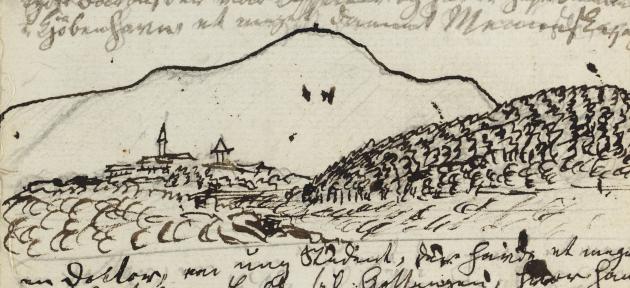
Photo: H. C. Andersen (1805-1875)
The diaries were mainly kept during Hans Christian Andersen's many trips abroad and on events of importance such as war, illness and death. Until 1861, most of his diaries came from trips abroad, while the early entries often formed the basis for later travelogues. From 1861 until his death in 1875, Andersen kept a diary consistently and usually every day – both at home and on his trips. The diaries also contain more than 340 illustrations.
The original almanacs, with one exception, are preserved in the collections of Royal Danish Library, just as the majority of the original diaries can be found here.
Flowers in the Almanacs
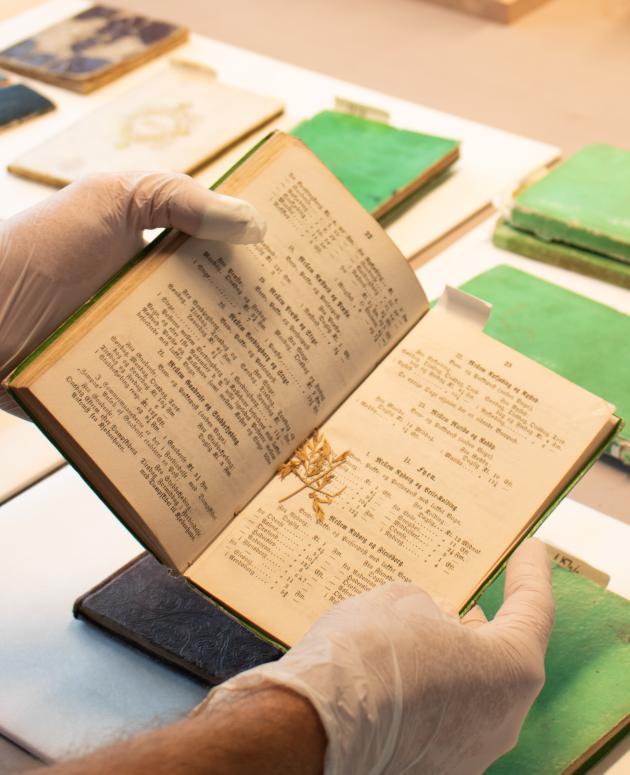
Photo: Det Kgl. Bibliotek
For four decades, Hans Christian Andersen kept almanacs. On his travels and walks in Denmark and abroad, he collected flowers and leaves, some of which he placed inside his almanacs. They are still there today.
Portraits of Hans Christian Andersen
Hans Christian Andersen was the most photographed Dane of his time. Between the first known photograph of him, taken in 1843 and now lost, and Georg E. Hansen’s final photographs of Andersen in 1874, more than 150 photographs of the author were taken.
Andersen himself was interested in photography and wrote about visits to photographers and his own portraits in his diaries and letters. Royal Danish Library’s collections contain numerous photographs and portraits of Andersen. Some are available online through the library catalogue, while others can be ordered for viewing in the reading room.
The photographs are not included in the digitisation project for manuscripts and letters.
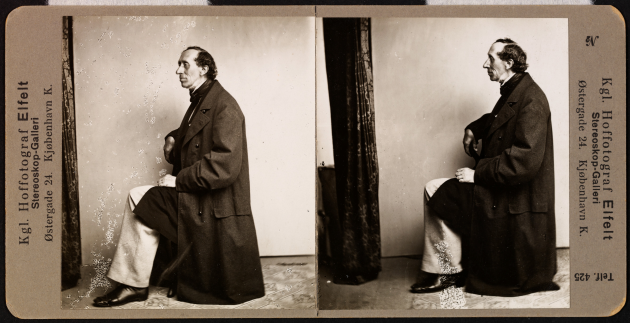
Photo: Peter Elfelt (1866-1931)
Go exploring
In 2025-2027 we will digitise all of Hans Christian Andersen's manuscripts and letters. You can explore Royal Danish Library's digital collections online and see how far we have come.