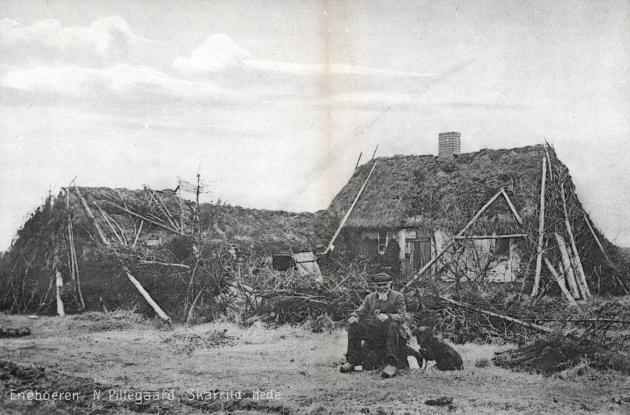
Postcard photographs as a historical source
The postcard collection is a good historical source of events in Denmark, and shows the significant change that occurred in just a few years in towns and villages around the country.
Photographic images of towns, villages, landscapes, memorials and people together form a kaleidoscopic portrait of a Denmark that changed rapidly during the 20th century. The collection contains not only postcards from Denmark's larger cities such as Odense, Næstved and Nykøbing Falster, but also from small villages in every part of the country. It is particullarly in these that the contrast between past and present can be seen clearly. Shops that have disappeared, schools that have closed and dairies that now stand empty. The photographic postcards therefore constitute a remarkable source of Denmark's cultural and historical development. Through them, one can see with their own eyes how towns, villages, people and nature changed radically in just a few decades.
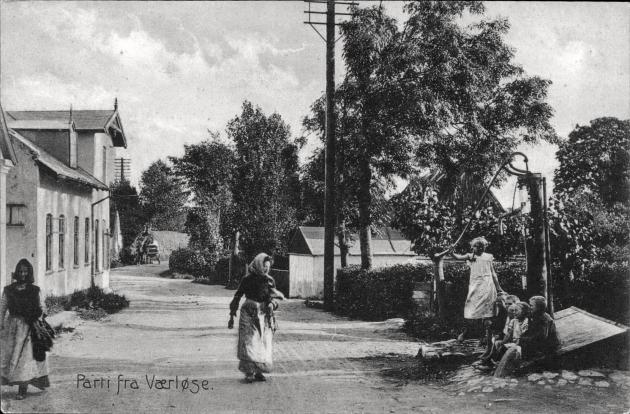
Photo: Carl Stenders Kunstforlag (1888-1995).
Postcard collecting is fascinating for everyone, as photographs have a way of speaking to the viewer that makes history come alive. Photography captures – almost as if by magic – a fleeting moment of past reality and presents it to modern times in a direct and concrete way (“So that is what it looked like! That is how they dressed!”), while often also inviting us to imagine the lives the people in the picture may have lived. What was it like to stand in exactly that spot where the photographer stood, at the very moment the photograph was taken?
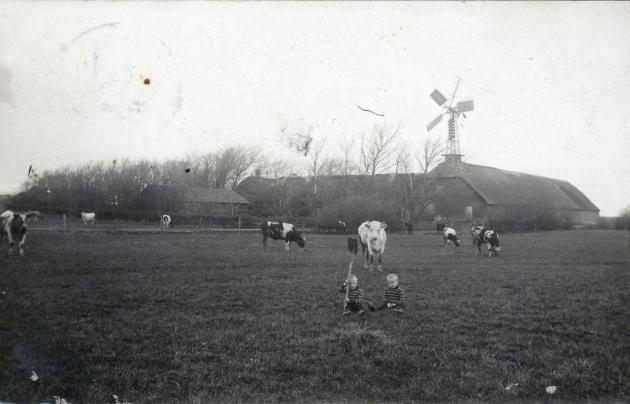
Photo: Ubekendt ophav.
Because most postcards have been assigned a location, users can search geographically within the postcard collection on digital collections. For example, for the town or village where you grew up. Through the postcards that appear, it becomes possible to see how an area looked and developed over the decades. In addition, the collection contains a large number of postcards featuring photographs of both named and unidentified farms. So you may be lucky enough to discover pictures of your very own farm.

Photo: Ingeborg (Ingeborg Agnes Margrethe) Hansen (1872-1955).
The postcard collection does not only consist of postcards depicting urban and rural life. Postcards portraying people were also popular at the time, and the collection includes subjects ranging from local postmen and rescue workers to playful schoolchildren and children from orphanages. However, it should be noted that the scenes may have been staged and are therefore not necessarily completely truthful. In some cases, the postcards may even feel exploitative, placing the people depicted on display as social outsiders. One may therefore question whether they consented to becoming subjects of postcards. Nevertheless – or perhaps precisely because of this – it can now help to put a face on people who were not normally depicted. Together with the urban and landscape postcards, provides an even better insight into what society was like at that time.
Small cards, great stories
It is not only the motifs on the postcards that may be interesting. Sometimes you are fortunate that the messages written on the postcards themselves tell a personal, culturally significant or socially revealing story. In such cases, the postcards can help us understand the context in which they were written. What occupied people’s minds, either in society at large or personally to the sender, at the moment the card was written? Although the open format of the postcard hardly invited the sharing of deep secrets, there are nevertheless many examples that offer touching glimpses into the lives and thoughts of ordinary people.


Wind and weather
Like many other interesting subjects and events, dramatic weather phenomena were occasionally documented on postcards as well.


Summer becomes winter – manipulated and edited postcards
Selling postcards was, of course, a business intended to make a profit. For that reason, the same postcard motifs were often reproduced with major or minor changes. Black-and-white images were colourised, faint lines were redrawn, and even the seasons were changed. There are many funny examples of this in the postcard collection. The alterations succeeded to varying degrees and emphasise that postcard motifs cannot always be used uncritically as historical sources.


Royal Danish Library's postcard collection
It is not known when the topographical postcard collection was established, but the photographic collection can be dated to 1902.
The topographical postcard collection consists of approximately 310,000 mandatory deposit, purchased, or donated postcards featuring either photographic or illustrated motifs. The postcards mainly cover the period from around 1905 to 1950, although both earlier and more recent postcards are also included.
The photographers are often unknown – in such cases, the publisher or bookseller is typically listed as the creator. The postcards are dated based on the printer’s, publisher’s, or the Royal Danish Library’s stamp, the sender’s dating, or the postmark. For this reason, dates are given as approximate.
Please note whether a postcard is free of copyright if you wish to use it for anything other than private purposes.