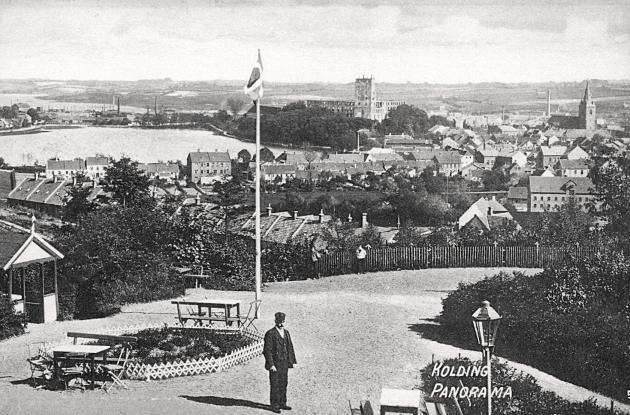
The City of Kolding
The topographical postcard collection contains a wealth of postcards from Danish cities. These motifs can help us see what a city like Kolding looked like around the beginning of the 20th century
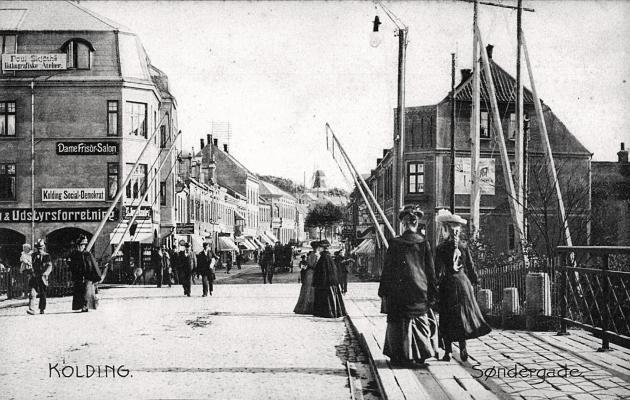
Photo: Carl Stenders Kunstforlag (1888-1995).
A walk through Kolding at the beginning of the 20th century
It is a cool morning, and the people who have ventured out onto the busy street are wrapped up in warm coats and cloaks. A woman walks alongside a younger girl, whose braid is tied tightly beneath her light-coloured hat. A gentleman on the opposite side of the road carries a small child on his arm. Further down the street, a horse-drawn carriage rattles over the cobblestones, and the town hums with the movement of shoppers going in and out of the many shops.
We find ourselves on Søndergade in Kolding at the beginning of the 20th century. A bustling commercial town – close to the then German border – which at the time had a population of around 13.500.
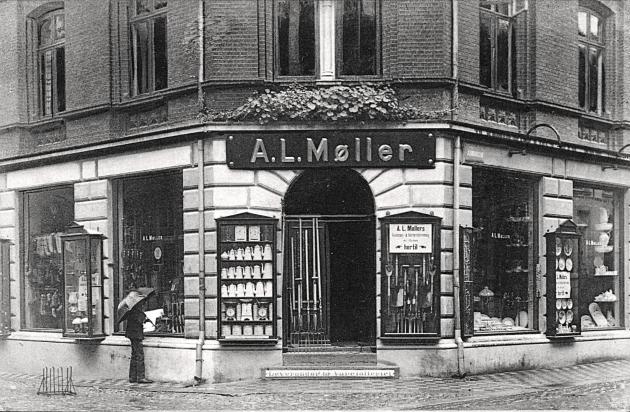
Photo: G. (Georg Valentin Harald) Burcharth (1874-1935).
The man carrying the child walks purposefully across the bridge with his eyes fixed on the ground – he cannot risk stepping in the horse droppings scattered across the cobblestones. He is on his way to A. L. Møller’s Ironmongery at Jernbanegade 24, about 450 metres from the bridge at Søndergade. In the shop, he can buy the shovel he needs for his garden at home. Meanwhile, the little one can look around curiously at the coffee pots, plates, clocks and other intriguing items sold in the shop.
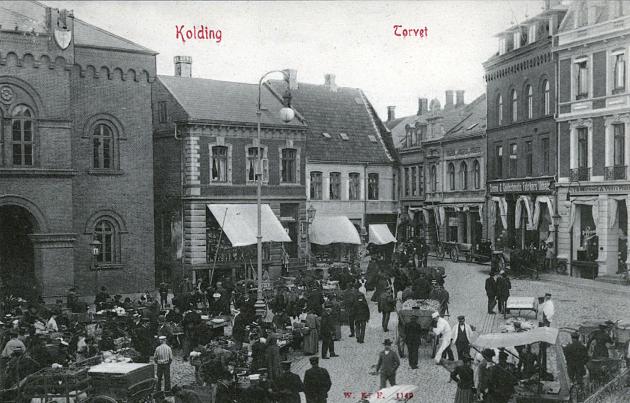
Photo: Warburgs Kunstforlag (1901-1911), Johan Otto Warburg (1877-1936).
But a new shovel is not the only thing the man and the child have been sent into town to buy: back home, they are short of both ink and paper, so they continue further up Jernbanegade. Here, they are met by the sounds of shouting vendors and chatty shoppers. It is market day, and Akseltorv is filled with bustling stalls, where men and women in hats stand close together, inspecting the goods available.
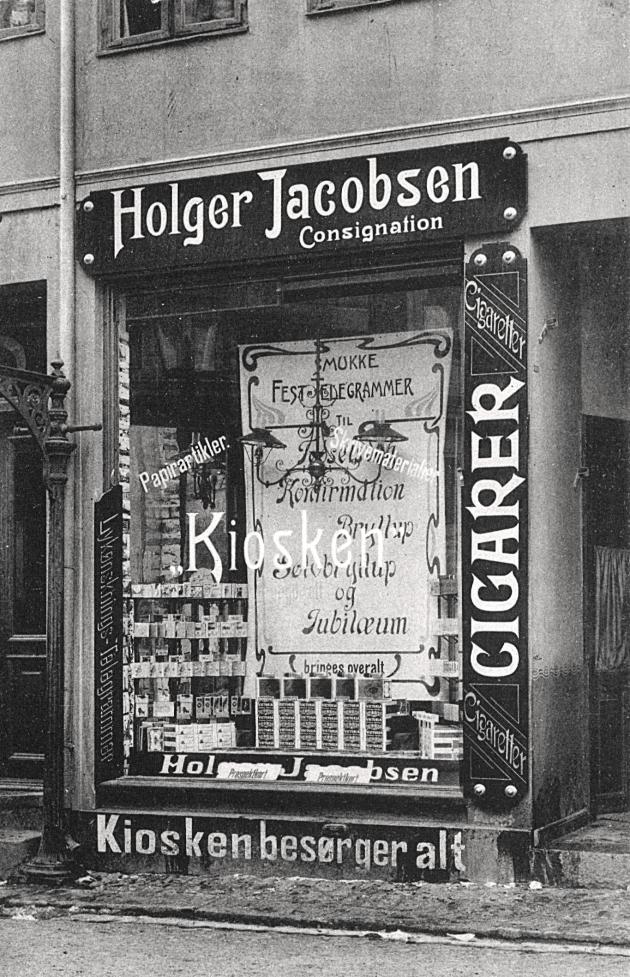
Photo: G. (Georg Valentin Harald) Burcharth (1874-1935).
After pausing for a moment to observe the vendors and traders, the man and the child continue past the square to Holger Jacobsen's shop "The Kiosk" at Adelgade 19. The small shop is well stocked with goods, and in the shop window there are advertisements for "Beautiful Festive Telegrams", paper goods, and writing materials. After a polite exchange with Mr. Jacobsen about the bustle of the market and the unusually cool weather, the man buys ink, paper and a packet of cigarettes. After a moment's consideration, he also purchases a fine little "picture postcard" featuring a photograph of Koldinghus. It is to be sent with greetings to his in-laws in Copenhagen.
After pausing for a moment to observe the activities of the vendors and traders, the man and the child continue past the square to Holger Jacobsen’s shop, "The Kiosk", at Adelgade 19. The small shop is well stocked with goods, and in the shop window there are advertisements for ‘Beautiful Festive Telegrams’, paper goods, and writing materials. After a polite exchange with Mr Jacobsen about the bustle of the market and the unusually cool weather, the man buys ink, paper, and a packet of cigarettes. After a moment’s consideration, he also purchases a fine little ‘view card’ featuring a photograph of Koldinghus. It is to be sent with greetings to his in-laws in Copenhagen
With the goods in his pocket, the shovel in his hand, and the child in his arm, the man leaves the shop and walks down Adelgade. Past horse-drawn carriages, bakers, tailors, and butchers, over the cobblestones, through the cold, towards home.
The city walk referred to above is of course partly imagined. We cannot say with certainty what purpose the man and the child had in town that day, or which shops they visited. However, the account illustrates how the postcard collection can in fact be used as an early form of Google Street View. Postcards depicting buildings and specific shops together provide a unique opportunity to compare how a town looked throughout the 20th century with how it appears today. In Kolding, there are even examples of postcard motifs taken in the same location several decades apart. For example at Banegårdspladsen, where one can clearly see the transformation the townscape underwent over just a few decades.


Changing times – the arrival of cars in the townscape
In photographs from the earliest postcards, there is one thing in particular that looks strikingly different compared to Denmark's streets and roads today: there are (almost) no cars. In the pictures, people walk leisurely in the middle of the road, stepping aside at most to make room for a horse-drawn carriage.


Although the first cars arrived in Denmark as early as the 1890s, it was many years before they made a visible impact on the cityscape, and even longer before they became commonplace. This did not, however, prevent the people at the time from already imagining what a future with automobiles might look like – also in a town such as Kolding.In a postcard from around 1907, the illustrator Carl Røgind (1871–1933) thus imagined townspeople and horses having jump out of the way as an automobile speeds down Østergade. Note that the drawing has been created on top of a photographic postcard from the same period.
People in the city
Postcards can help put faces to the people one might once have encountered in a town like Kolding. People of different ages, genders, appearances, and occupations. Who delivered the post to Mr and Mrs Jensen? Who looked after Kolding’s young children when their parents had to work? Just like the street scenes and shopfronts, these portraits tell their own stories, ranging from fashions in clothing and hairstyles to institutions and professions that no longer exist today. The postcard collection contains a number of motifs from Kolding in which the town’s inhabitants are brought to the fore. Here is a small selection of them.
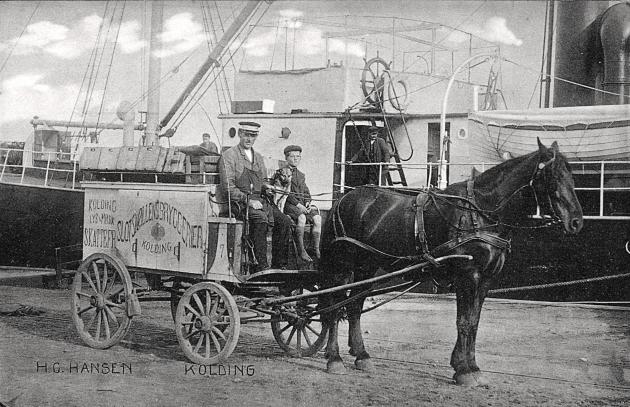
Photo: Poul Jørgensen.
Down by the harbour, a photographer has captured a haulier from Slotsmøllens Bryggerier, perhaps just before or after completing the day’s round. The carrier offers the camera a slight smile, while the barefoot boy at his side looks more sceptical. The men on the ship watch the scene with curiosity.
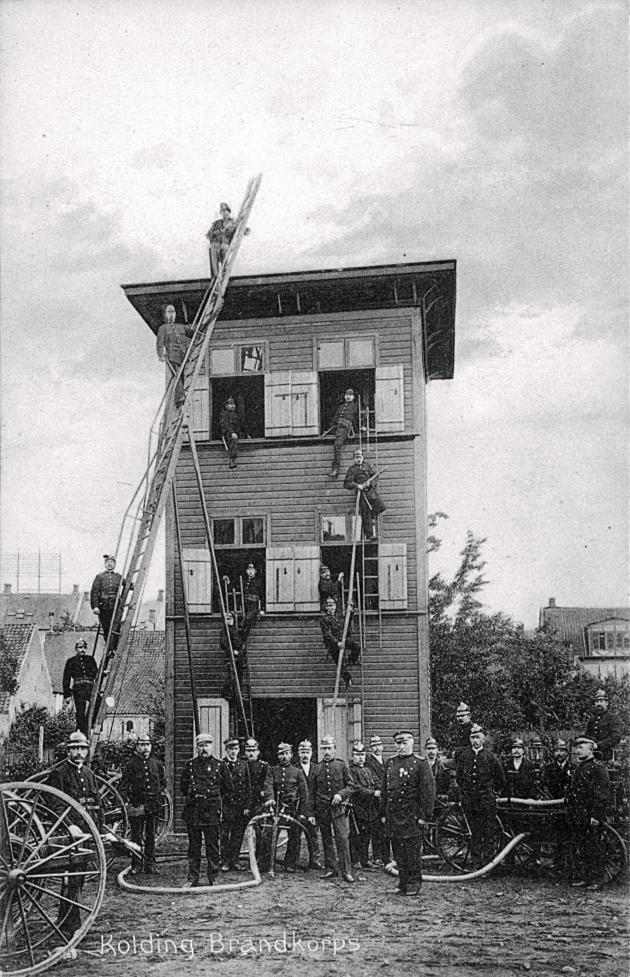
Photo: K. M.
At Kolding’s fire station in Vestergade, they must have known well in advance that a photographer would be coming by. Ladders, hoses, and engines have been brought out, and several of the firemen have taken up precarious positions on the drill tower. The older gentleman with medals on his chest has positioned himself at a suitable distance from the rest of the crew. The viewer should have no doubt that he is the fire inspector.
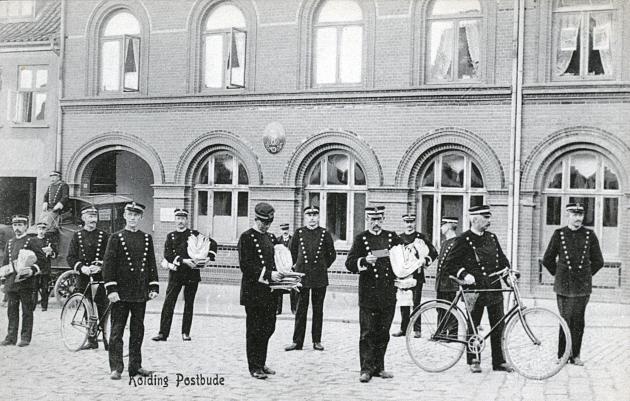
Photo: Warburgs Kunstforlag (1901-1911).
At Vestergade 4–6, the town’s postmen stand with large, bulging bundles of newspapers under their arms, ready to deliver the day’s post to the citizens of Kolding as soon as the photographer has finished. As with the fire brigade, it is most likely that the postmen have assembled for the occasion. It was clearly important to display the postal service’s horse-drawn carriage and bicycles for the photographer.
Kolding’s first nursery was established in 1906 and was located in Skolegade. A few years later, the photographer Georg Valentin Harald passed by with his camera and took this photograph. A group of children of various ages are arranged together with two adults and a large, good-natured dog. Several of the children look curiously towards the camera. Perhaps it is the first time they have seen one? Nurseries were not yet very common at the beginning of the 20th century, which may help explain why this scene was sold as a postcard motif.
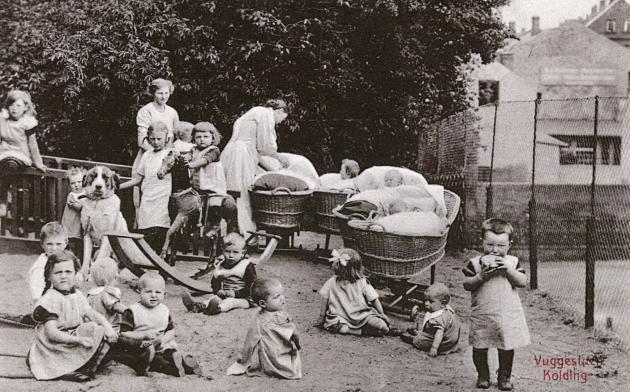
Photo: G. (Georg Valentin Harald) Burcharth (1874-1935).
Royal Danish Library's Postcard Collection
It is unknown when the topographical postcard collection was established, but the Picture Collection can be dated to 1902. The topographical postcard collection consists of approximately 310,000 postal cards which have been delivered, purchased or donated; and that either have a photographic or illustrated motif. The postcards primarily cover the period from around 1905 to 1950, although both earlier and later examples also occur. The photographers are often unknown – in such cases, for example, the publisher or bookshop is indicated as the originator. The postcards are either dated on the basis of stamps from the printer, publisher, or the Royal Danish Library, the sender’s date, or the card’s postmark. As a result, the date is given as an approximation. Please note whether a postcard is free of copyright if you wish to use it for purposes other than private use. Access the postcard collection in the digital collections here.