OCR scanning of 839 books from Royal Danish Library's book collection
Read about how a researcher made use of data provided from Royal Danish Library's collections and the Danish Books on Demand service in his research project.
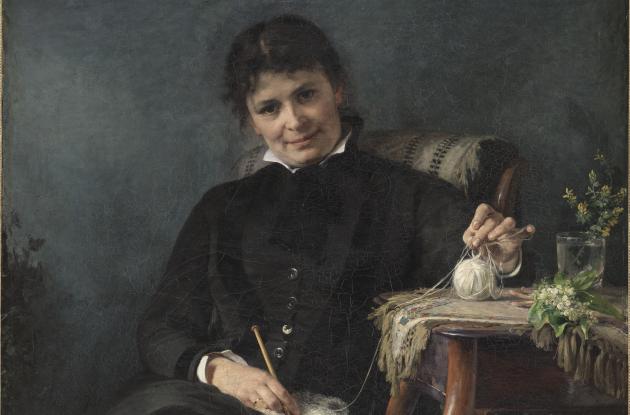
Photo: Bertha Wegman/SMK
In my broad, quantitative exploration of novels from the “modern breakthrough” in Danish and Norwegian literature, I have not only benefited from Royal Danish Library’s book collection, but also from the great and excellent work of the digitisation department in digitising the hundreds of novels (known, but mostly unknown; high-brow as well as low-brow). While the library’s users have had immediate access to all these books via the library system, in my research project we have enjoyed being able to explore quantitative patterns and identify new interesting individual texts in a large overall corpus, which is based on the digital images and (OCR) text recognition which Royal Danish Library has provided.
More about the project
| Project name | MeMo – Measuring Modernity: Literary and Social Change in Scandinavia 1870-1900 |
|---|---|
| Researcher | Jens Bjerring-Hansen, Associate Professor, Department of Nordic Studies and Linguistics, University of Copenhagen |
| Publications based on the project | |
| Service from Royal Danish Library | Danish books on demand, where you can order a PDF copy of selected Danish books, printed sheet music or material from the small print collection printed more than 100 years ago. |
| Material from Royal Danish Library | OCR scanning of 839 books from Royal Danish Library's book collection. |
The researcher elaborates
"The empirical material consisted of all Danish and Norwegian original novels (that is, not reprints and translations) printed in book form in Denmark during the period 1870-99. The basis for the collection was first and foremost the Danish Book Register, which the library's collection (almost) completely covers in terms of legal deposit. Aesthetically and sociologically, these many novels provide a diverse picture of the modern breakthrough prose in contrast to the more selective and canonical selection of material in literary histories.
There were well-known names (including Bang, Jacobsen and Hamsun) and advanced -isms (including naturalism and symbolism), but also a rich selection of popular literature (for example, romances and crime novels) and forgotten literary movements (school teacher literature, missionary literature and so forth) as well as, for example, what is known to be the first novel in the world with an openly homosexual protagonist (Nina by Otto Martin Møller from 1883)."


