String Quartets in the Diamond: Quatuor Ébène – Beethoven's String Quartets (5:6)
Hear Beethoven’s 16 string quartets across six concerts in the Queen’s Hall as the French star quartet Quatuor Ébène returns to The Black Diamond. This evening’s programme features Nos. 2, 16 and 14.
Programme
Ludwig van Beethoven (1770-1827):
String Quartet No. 2 in G major, Op. 18
String Quartet No. 16 in D major, Op. 135
Intermission
String Quartet No. 14 in C# minor, Op. 131
What do Beethoven's string quartets sound like 200 years after the composer's death?
In 2020, to mark Beethoven’s 250th birthday, Quatuor Ébène released all 16 of Beethoven's string quartets. The recordings were made all over the world, from Nairobi to Melbourne, and they received great praise for their contemporary interpretation.
Quatuor Ébène itself describes Beethoven's music as "music that expresses itself freely and that addresses the audience of the future rather than its own time."
Beethoven's 16 string quartets have taken pride of place in the chamber music repertoire, and they show his creative development as a composer. From the earliest Viennese Classical string quartets written in the wake of the genre's earlier masters, Haydn and Mozart, through the "middle period" when Beethoven broke with tradition and made the genre his own, and to his late string quartets written in the years leading up to his death, which have been called some of the most sublime music ever written.
String Quartet No. 2, No. 14 and No. 16
The concert opens with String Quartet No. 2, which is from Beethoven's first collection of string quartets (nos. 1–6). The works were composed between 1798 and 1800 during Beethoven's early period, which is written in the Viennese Classical style. The collection is dedicated to Prince Franz Joseph Maximilian von Lobkowitz, who was known for his interest in music and later became Beethoven’s patron.
When Beethoven published his first collection of string quartets, he joined the ranks of great composers who had mastered the classical Viennese string quartet. Both Mozart and Haydn had already completed their string quartets by this time, and Haydn wrote his last two in 1799, the same year Beethoven was working on his first quartets.
String Quartets No. 14 and No. 16 are some of Beethoven's last string quartets from his "late period", which is more ambitious, experimental and structurally and harmonically complex. The string quartets from this period are now considered to be some of the most "sublime" music ever written, and to be far ahead of their time. Despite this, they were written during a period when Beethoven had gone through a long series of personal tragedies. He suffered from both health and financial difficulties and in 1816 had become completely deaf, which isolated him.
In November 1822, Beethoven received a letter from a young Russian prince, Galitzin, asking him to write a series of new string quartets, marking the beginning of Beethoven’s final and perhaps greatest musical achievement. Prince Galitzin had originally commissioned three string quartets (Nos. 12, 13, and 15), but Beethoven continued to compose, resulting in String Quartets Nos. 14 and 16.
String Quartet No. 14, many would say, is the greatest of them all, and was Beethoven's own personal favourite. The work’s extraordinary reputation is reflected in the fact that it was Schubert's last wish to hear it, and that Wagner devoted an entire essay to its greatness. With seven movements, it is also the longest of all his string quartets.
The String Quartet No. 16 is the last major work Beethoven completed, and his final opus, Op. 135. He completed it in October 1826, five months before his death in March 1827. The work is more conventional and classical in nature than the other late quartets and has four movements like his earliest string quartets. It can be seen as a distillation of his musical style, a return to the freshness and vitality of the young Beethoven, while still carrying the depth of his older style.
All the concerts in the series
You can read more about the programme on the concerts' event pages:
January 15 at 7:30 PM - String Quartet No. 5, No. 4 and No. 12
January 16 at 3:00 PM - String Quartet No. 3, No. 11 and No. 8
January 16 at 7:30 PM - String Quartet No. 1, No. 10 and No. 9
May 21 at 7:30 PM - String Quartet No. 7 and No. 13
May 22 at 3:00 PM - String Quartet No. 2, No. 16 and No. 14
Artists
Quatuor Ébène:
Pierre Colombet, violin
Gabriel Le Magadure, violin
Marie Chilemme, viola
Yuya Okamoto, cello
Quatuor Ébène was formed in 1999 at the conservatoire in Boulogne-Billancourt in France. Since then, the quartet has performed at internationally renowned venues such as Wigmore Hall in London and Carnegie Hall in New York. Their performances of Ludwig van Beethoven’s string quartets have also been heard at Philharmonie de Paris and Alte Oper in Frankfurt.
The quartet itself describes the string quartet as the musical form of democracy, in which each musician steps forward with their own voice while the whole emerges through shared interplay, attentiveness and mutual understanding.
Part of the series String Quartets in the Diamond
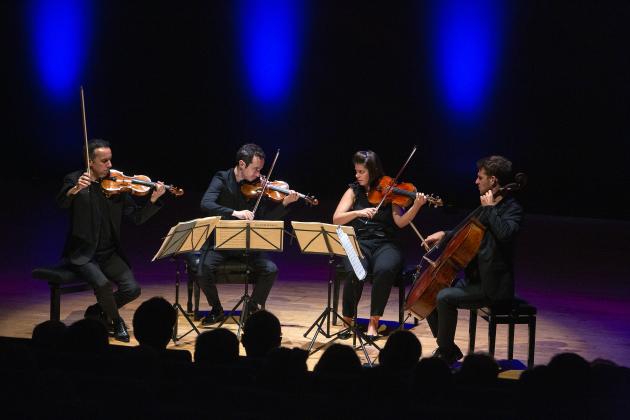
Photo: Ditte Valente / Det Kgl. Bibliotek
Some of the most central repertoire in chamber music is written for two violins, viola and cello.
In this series, the best string quartets from all over the world are invited on stage in the Queen's Hall.
The event is part of the series String Quartets in the Diamond.
String Quartets in the Diamond is supported by the Aage and Johanne Louis-Hansen Foundation and the Knud Højgaard Foundation.