Copenhagen Diplomatarium
A comprehensive collection of transcribed sources and register descriptions which illuminate the history of Copenhagen from the end of the 12th century until the first quarter of the 18th century.
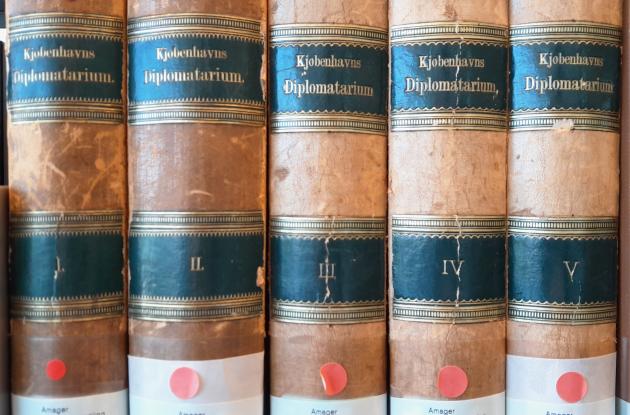
Photo: Lars Kjær
The material behind the dataset
Copenhagen Diplomatarium or Kjøbenhavns diplomatarium: collection of documents, letters and other sources for information about Copenhagen's older affairs before 1728, which is the actual title of the work, is a comprehensive collection of transcribed sources and register descriptions which can shed light on the history of Copenhagen from the end of the 12th century to the first quarter of the 18th century. The original, physical edition consists of 10 volumes including two register volumes. The work was first published by Gads forlag between 1872 and 1887, and the work was published by historian and archivist at Copenhagen town hall archive Oluf Nielsen (1838-1896). It has subsequently been published in new editions, and is available at most Danish libraries. Read about the work in our library system.
The texts are mainly written in medieval Latin and Middle Danish and are thus not only sources of Copenhagen's political, cultural, economic and social history, but also sources of historical language, spelling, and wording.
About the dataset
Together with the digital edition, Royal Danish Library publishes Copenhagen Diplomatarium as a structured dataset, so that the sources can be used in computer-based analyses. The dataset is available as a csv file consisting of metadata and content and as unformatted .txt files. Data is also available in .html and .txt formats.
The data quality is good. The material has been digitized with OCR, but has subsequently been proofread twice.
The dataset is free of copyright.
The creation of the dataset
Former curator at the Copenhagen Museum and board member of the Society for Copenhagen History, Jan Möllerström, was behind the digital edition. The digital edition was produced from autumn 2002 to spring 2003 and was carried out as a private project. The digital texts were produced using OCR technology and were followed up by two thorough proofreads, so that the electronic edition is of very good quality and identical to the printed edition. The digital edition was available online until 2023. It has been preserved for posterity in the library's internet archive, netarkivet, and is available for download from the library's open online archive LOAR (Library Open Access Repository).
Find datasets and guidance material
The digital version is freely available to everyone via the library's digital archive – LOAR (Library Open Access Repository). From LOAR, the digital version can be downloaded and unpacked onto your own computer. This way, you can enjoy browsing between the pages in the same way that the website originally allowed. At LOAR, the digital version is also available as a dataset, so that the collection can be used for computer-based research.