Bo of Denmark returns home
New manuscript in the library's collections from one of the most significant Danish thinkers of the Middle Ages.
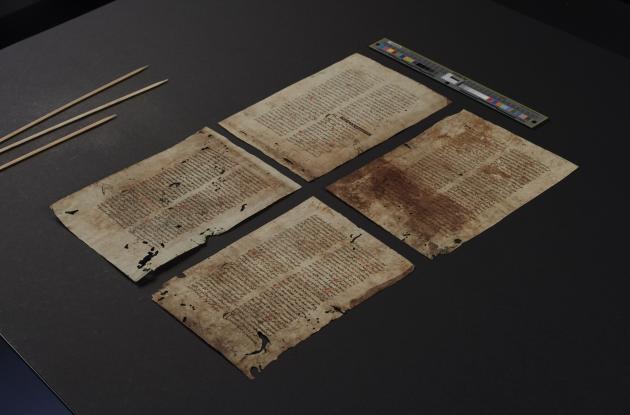
Photo: Det Kgl. Bibliotek
Published 27 November 2025 | Revision 01 December 2025
Royal Danish Library has acquired a rare medieval fragment of the work "De modis significandi" by Boëthius de Dacia. Bo of Denmark – as we will call him in Danish – is possibly the most significant Danish philosopher before Kierkegaard.
The new acquisition provides a rare insight into the intellectual life of the Middle Ages. At the time, Bo of Denmark's wild ideas caused such a stir that a Parisian bishop felt compelled to ban them. Although we know very little about Bo of Denmark, he is one of the most significant Danish thinkers of the Middle Ages. He taught at the University of Paris in the 1270s and attracted so much attention that many of his thoughts ended up on a list of forbidden doctrines which the Bishop of Paris issued in 1277. Shortly thereafter, he disappears from the sources without a trace.
Now, Royal Danish Library has – with support from the Augustinus Foundation – acquired a fragment of the work "De modis significandi", a work on medieval language theory. This is probably the first time that a manuscript by Boëthius de Dacia has found its way to Denmark.
Selvom Bo af Danmark måske ikke er kendt af mange danskere i dag, er han faktisk en af Danmarks største filosoffer. Han tog kampen op mod kirken, og hans skrifter vidner om, at viden og dannelse også i den fjerne fortid var med til at styrke befolkningen gennem kultur. Med fragmentet får vi ikke blot et sjældent glimt ind i Europas og Danmarks idéhistorie – vi bringer også en central skikkelse i dansk filosofi hjem. Stor tak til Augustinusfonden for at gøre det muligt.
Photo: Det Kgl. Bibliotek
Bo wrote at least 27 works that were widely distributed in the Middle Ages. He influenced logic, philosophy of language, and what we would today call epistemology. What, among other things, caused a stir among the bishop and his like-minded people in Bo's time was that Bo believed that everything can be debated with arguments based on reason, even though these arguments do not necessarily lead us to an unshakable truth. In the religious world of the Middle Ages, this was not a given – and it did not go down well with, among others, the bishop of Paris, who banned a number of teachings from Bo's hand.
We do not know whether the writings ever reached Denmark – but his importance for the European intellectual tradition is undisputed.
I en tid, hvor dansk middelalder ofte forbindes med vikinger og bondesamfund, minder Bos skrifter os om, at der fandtes danske tænkere med udsyn og indflydelse langt ud over landets grænser. At hans værker ikke på forhånd findes i Danmark, gør erhvervelsen desto vigtigere. Jeg var selv nede og besigtige og købe fragmentet, og det var et kæmpe privilegium.
Background about the fragment
- The newly acquired manuscript consists of four parchment leaves from De modis significandi, a work on medieval language theory. At some point, the manuscript was taken apart and the leaves reused as binding material for other books. It was in one of these bindings that a German conservator discovered the fragment many years later.
- An expert from Sotheby's identified the fragment as being by Boëthius de Dacia and contacted Royal Danish Library, after which the library's own specialists were able to confirm it.
- Since the manuscript was both in good condition and linked to Denmark's most important medieval philosopher, the library, with support from the Augustinus Foundation, decided to attempt to acquire it.
- The next step in the process will be to make a copy of the text, and together with expert in medieval philosophy Sten Ebbesen, to compare it with other manuscripts of the same text and try to find out where the new manuscript comes from more precisely.
Fragment of Boëthius de Dacia's De modis significandi
The manuscript has already been digitized and can be viewed in the library's collections.
Royal Danish Library's work with cultural heritage
The Library has a number of researchers and experts who work every day to collect, preserve, and disseminate Denmark's physical and digital cultural heritage – from newspapers and manuscripts to commercials, music, and the internet. We make cultural heritage accessible to everyone.