Ole Lund Kirkegaard
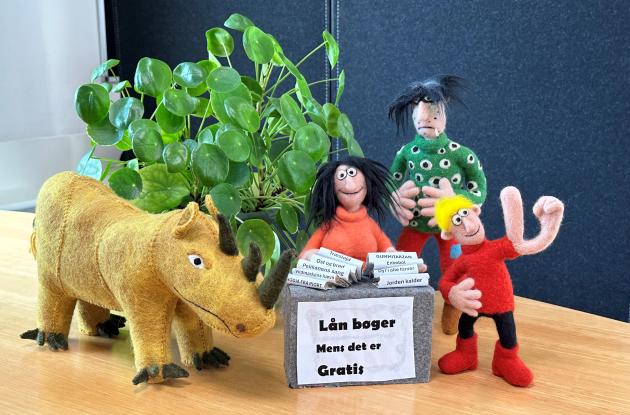
Exhibition with Ole Lund Kirkegaard's illustrations and authorship.
Ole Lund Kirkegaard's books bring us into a humorous universe, where he creates absurd scenes and quirky characters in words and illustrations.
His stories resonate with both children and adults because we recognise ourselves and the challenges the characters face.
The stories contain empathy for the small and weak, and Ole Lund Kirkegaard uses his humorous approach as a reminder that the crooked and imperfect have their own strength and value. That we should be critical of authorities, and that the funny and life-affirming often arise in the imperfect.
Is Otto a rhino? HONK! YEAH!
Welcome to Ole Lund Kirkegaard's quirky universe
The boy Topper finds a carpenter's pencil on the sidewalk and draws a rhinoceros on his yellow wall. The pencil turns out to be not an ordinary pencil, but an enchanted one! The yellow rhinoceros comes to life and steps out of the living room wall of the red house where Topper lives – above Café Den Blå Havkat. The rhinoceros says GRUMP, HONK and HORK and eats the curtains, a stuffed parrot – and rye bread in unusually large quantities.
The children’s novels of Ole Lund Kirkegaard bring the reader into a quirky and humorous universe where the author creates absurd scenes populated by funny characters. His stories resonate with both children and grownups because we recognize ourselves and the challenges the characters encounter.
The stories hold empathy for those who are small and vulnerable and Ole Lund Kirkegaard uses his humourous approach to remind us that what we tend to label weird or imperfect often has its own unique strengths and values.
That we should take a critical stand towards socalled authorities and that the positive and life-affirming parts of life often emerge from what we tend to look on as weird and imperfect.
You can meet Otto and Topper and a whole range of other well-known characters and creatures as you explore our exhibition in the library's lobby and on our 1st and 2nd floors.
The library marks that one of the most significant authors of Danish children's literature – Ole Lund Kirkegaard (1940 – 1979) – would have turned 85 on July 29, 2025.
Enjoy!
Thank you
The exhibition has been created in close collaboration with Ole Lund Kirkegaard's daughter Nana Bang Kirkegaard, who has generously made her father's illustrations available to the library.
All the illustrations on display have been digitized from Ole Lund Kirkegaard's original drawings.
We have been allowed to borrow a large number of illustrations from the following works for the exhibition:
- Orla Frøsnapper (1969)
- Hodja fra Pjort (1970)
- Otto er et næsehorn (1972)
- Gummi Tarzan (1975)
- Farvel og Tobak – anti-tobacco campaign (1979)
The exhibition includes a number of objects and documents from Nana Bang Kirkegaard's private archive.
We have also been allowed to borrow the figures of Otto and Orla Frøsnapper from Skanderborg Public Library, which hosts an annual event called "Sløngeldage" (Rascal Days) every spring in the town where Ole Lund Kirkegaard was born and grew up.
Thilde Kirkegaard has drawn Topper, whom you can meet on the 1st floor next to Vejledningen (User Assistance)
Henrik Dannevang has made the felt figures of Orla Frøsnapper, Gummi Tarzan and The Librarian.
Special thanks to Nana for making the exhibition possible and facilitating good contacts. Thanks to Thilde for drawing Topper on our wall and thanks to Henrik for creating Orla, Gummi Tarzan and The Librarian. Thanks to Skanderborg Public Library for letting Otto and Orla visit us.
Theme texts
A magic pencil and a prolific authorship
Ole Lund Kirkegaard has written and drawn literary works that have long since been included in the Danish children's literary treasure trove – books which adults have read together with their children and grandchildren since the late 1960s.
Lille Virgil, Otto, Orla Frøsnapper, Gummi Tarzan and Hodja are characters that populate Ole Lund Kirkegaard's literary universes, along with a colorful array of other remarkably recognizable adults and children. People who are at once very special and at the same time have populated many of the classrooms, schoolyards and small towns that we have all grown up in.
Ole Lund Kirkegaard unfortunately did not live to old age. He has however written a number of children's books that have achieved the status of timeless Danish classics and are read across generations who can recognize themselves and their surroundings in the stories. Ole Lund Kirkegaard wrote eight books in twelve years: Lille Virgil (1967), Albert (1968), Orla Frøsnapper (1969), Hodja fra Pjort (1970), Otto er et næsehorn 1972), Gummi Tarzan (1975), En flodhest i huset (1978) and Frode og alle de andre rødder (1979) - He did not manage to finish Frode og alle de andre rødder himself, which was therefore finished by his family and, along with a number of other shorter stories, published after his death.
Humour and imagination: Educational magic tools
Ole Lund Kirkegaard's writing represents a significant breakthrough in the way of writing books for children and has references that point back to great literary classics such as Mark Twain's Adventures of Tom Sawyer and Huckleberry Finn.
His debut novel about Lille Virgil was published the same year as Benny Andersen's Snøvsen og Eigil og katten i sækken (1967), Cecil Bødker's Silas and the black Mare (1967), Halfdan Rasmussen's ABC (1967), Flemming Quist Møller's Cykelmyggen Egon (1967) and constituted a revolution in Danish children's literature - and points forward to the authorships of contemporary Danish writers such as Bjarne Reuter, Kim Fupz Aakesson and Jakob Martin Strid.
Ole Lund Kirkegaard's universes contain elements of a very recognizable, realistic world with surprising magical elements that take the reader on an adventure in the company of the main characters of the stories. The main characters are curious, energetic children, often boys, who turn the adult world upside down through their actions and questions.
The stories deal with universal themes from our common lives: Growing up, power relations, friendship, love and freedom, which the main characters encounter and navigate in different ways on their way through the stories.
Ole Lund Kirkegaard uses both language and drawings to make his readers laugh at the crazy ideas, feel sympathy for the hardships the main characters and rejoice at seeing a tyrant leave the village with the traveling circus, so that the world calms down again - for a while.
Ole Lund Kirkegaard was both an illustrator, painter, author, debater and lecturer, and he fearlessly intervened in the debates of his time about children, school, pedagogy, teaching and literature.
His books have changed the way language and illustrations are used in children's literature and treat themes such as bullying, dyslexia, parental roles and children's roles with a humorous and devilish strength that makes the works highly entertaining and universally relevant.
In the exhibition, you can experience a number of Ole Lund Kirkegaard's illustrations, which together with the stories form an integrated, artistic whole that was innovative in Danish children's literature when the books were published.
A childhood wearing clogs and climbing plum trees
Ole Lund Kirkegaard grew up in Skanderborg in a respectable family – his father was a dentist, his mother tended the home. His parents gave him ample scope according to the standards of the time. The backyard of his childhood home was used for digging caves, climbing trees and creating clubs and circuses with his friends.
There was no tidy lawn or ruler straight lines of tulips - on the contrary, there were plum trees and pear trees and room for all sorts of experiments. The garden was a paradise of open space.
As a child in the 1940s and 50s, you could disappear into the landscape around Skanderborg with its hills, lakes and forests, without your parents monitoring your every movement. The action in Ole Lund Kirkegaard's stories often unfolds in surroundings that resemble the rural small town and hilly landscape of his childhood.
Ole Lund Kirkegaard graduated as a teacher from Aarhus Seminarium. He settled as head teacher and school principal with his wife Anne Lise in the small village of Oue by Mariager Fjord in June 1965.
An anti-authoritarian teacher – the children were his literary barometer
Ole Lund Kirkegaard was anti-authoritarian in every way and approached the job of teacher based on his own principles and intuition. In his childhood classroom, everyday life had been characterized by fear of the teacher's absolute authority and the possibility of corporal punishment.
In Ole Lund Kirkegaard's classroom, there was none of the above – no toe the line. On the contrary, Ole Lund Kirkegaard took care of the individual child and the child's starting point for learning and going to school, and he was concerned with having a trusting, secure and equal relationship with the children he was teaching. When a student, after hard work with difficult calculations, suddenly had an aha-experience, he would open the window towards the village and happily shout "HURRAY, HURRAY for that!" (Andersen 2010, p.162)
Ole Lund Kirkegaard transformed the completely traditional village school in Oue into a colorful universe – “a native American village with totem poles, a campfire, ropes and caves in the trees, aviaries with brightly colored birds and paintings on the asphalt of the schoolyard and on all the windows in the classrooms.” (Andersen 2010, p.15)
In Oue he also began to write and challenge the way books for children were traditionally written. He read his stories to the children in class and the children were both his inspiration and “subtly noticeable barometer” that determined what would remain in his manuscript (Andersen 2010, p.17)
Ole Lund Kirkegaard was a teacher and school principal in Oue until 1973, when the family moved to Urlev near Horsens for work and more private reasons. He also worked as a teacher there, but when writing demanded more and more of his time, he left his job at the local Stenderup School. He thus lost his daily contact with the children, with whom he had a close relationship as a teacher and who were also his greatest source of inspiration.
Increasing work pressure affected both family life, his marriage and his writing. The last years of Ole Lund Kirkegaard's life were turbulent and marked by ups and downs.
In the autumn of 1978, Ole Lund Kirkegaard was divorced. In his final years he struggled with alcoholism – a condition that had been present in his life for several years and which dominated the last part of his life. He died in March 1979.
A toad, an invisible gift and an imperfect literary “new beginning”
In the summer of 1966, Ole Lund Kirkegaard became known outside of Oue because he won the Danish national newspaper Politiken's competition: Write the "best story for children aged 7-15".
Out of 1600 entries submitted, he won the competition with the short story "Dragen" (1966), which became the outset for the book about "Lille Virgil" (1967).
In 1967, the spirit of the times was radically changing. Ahead lay the student uprising, the hippie movement and women's liberation. At the time, there were also movements that focused on liberating the child, and Politiken wanted to raise the status of children's literature and focus on the cultural needs of children with the competition.
In 1967, the Danish school system received a new legal basis when the Danish Parliament decided that teachers were no longer allowed to punish students in the country's schools. The focus was now on "the student's all-round development" and the school was to "respect and stimulate the child's nature and emotional life".
Ole Lund Kirkegaard challenged the established approach to writing for children, which was characterized by moralizing and instructive books written by adults for children, such as the Jan, Puk, De Fem and Kim books, which were still standard reading for all able-bodied girls and boys in the mid-1960s.
He wanted there to be an edge to the stories and they should not be told from an adult perspective, but at eye level with the children:
“My own experiences as a teacher and author tell me that you should write about the things that children are absorbed with on a daily basis, and you should then try to remember that children are not at all the little angels that people have often wanted to make them out to be in children’s books. For example, you should not deceive yourself and your readers that children cannot be mean to each other. They can, and unlike adults, they let their meanness towards their peers be expressed because they cannot control themselves.” (Andersen 2010, p. 23)
In 1966 - 67, the story of Lille Virgil, who lives alone in his chicken coop and drinks soda pops for breakfast , landed "like a UFO" in both the established children's book circles and among readers.
It was a radical breakthrough in both content and form. In Ole Lund Kirkegaard's books, drawings and text form an integrated whole and Ole Lund Kirkegaard did not cultivate neatness in either drawings or text, but was preoccupied with children's language and telling stories as simple as possible. The drawings have an exaggerated, caricatured and funny line and several of the main characters are described as "ugly" and imperfect with spiky hair, freckles and crooked teeth.
Gyldendal's initial plan was to find another illustrator for Ole's book about Lille Virgil. They thought his drawings were too ugly 😊 But Ole Lund Kirkegaard refused to publish his manuscripts if they did not include his own illustrations.
Sources
Nana Bang Kirkegaard
Jens Andersen, Ole Lund Kirkegaard, a life story, Gyldendal, 2010
Author web: https://forfatterweb.dk/oversigt/kirkegaard
Works
Orla Frøsnapper
The novel about “Orla Frøsnapper” is the universal tale of the lanky bully who terrorizes the young kids in his village. It is about the fear you can experience as a young and defenceless child facing an older child’s supremacy. As readers, we immerse ourselves in the dramatic – yet still humorous - scenes where Orla almost gets hold of us – and rejoice with the first-person narrator when he manages to trick Orla and get him into trouble. Orla is the archetypal bully who spends his time persecuting others. Not until the human cannonball, Don Kraus of Circus Benito, spots him and hires him as his successor, does Orla find his place in life. The young boys watch as Orla leaves town with the circus – perhaps feeling a little regretful that the excitement ends – and that they are too young to venture into the world with the circus?
Otto er et næsehorn
A boy named Topper finds a magic pencil and draws a rhinoceros on his yellow wall. The rhinoceros comes to life and is very hungry. It is also very heavy and falls through the floor with the other residents of the building – all the way down to Café Den Blå Havkat, where everything ends in apparent uproar – until, out of all the uproar, new sides of the residents of the house emerge. The grumpy Mr. Løwe becomes a happy café owner, a mature couple moves in together, a police chief comes to terms with the disorder of the world – and, last but not least, Topper's father returns home from a long journey across the seven seas and reunites with his family – and he knows exactly who wants a yellow rhinoceros.
The pencil is the magical tool of the story, which, as in classic fairy tales, starts a chain of events that turns Topper's life upside down, triggers a series of absurd and comical scenes, and challenges Topper, who must find solutions to the strangest problems. In the story, Otto eventually sails off to the South Seas and Topper must find new challenges – perhaps as Sille's boyfriend?
Gummi Tarzan
The story of Ivan Olsen is a universal tale about how you can feel completely awkward, ill-adjusted and unable to live up to the expectations that parents and society may have. The main character in the story is not particularly attractive, he is not strong or good at reading, and everyday life at school is generally a struggle for Ivan. With harsh humour, Ole Lund Kirkegaard shows us what lessons Ivan learns every day: he learns that at school, you get beaten up and bullied. There is no comfort or help to be found when he comes home because Ivan's mother just shakes her head, and his father thinks he is a spineless wimp and teaches him that a boy should be a real man – like Tarzan of the Jungle – and capable of beating up others.
The story of Gummi-Tarzan also contains a magical element – a friendly witch - who grants Ivan his greatest wish – but unfortunately only for a single day. Then everything returns to normal for Ivan Olsen.
The story differs from the others in its tragic ending. It gives the reader cause to consider how we treat others who do not fit into the patterns we ourselves help to create. And how do we fit in ourselves?
Hodja fra Pjort
The story of Hodja from the sleepy town of Pjort is structured like a classic coming-of-age novel. The boy Hodja is bored at home and dreams of leaving home to see the world. His father, a cross-eyed tailor, would like Hodja to stay at home and become a tailor like his father. But Hodja rebels against his father and leaves Pjort.
In this adventurous tale, the magical tool is a red, flying carpet that takes Hodja out into the colourful world he wants to experience - where he encounters evil and danger, but also meet good helpers who guide him through dangerous situations.
The story of Hodja does not end with Hodja returning home to his starting point in Pjort – he overcomes the dangers he meet and continues his flight on the magical red carpet crossing the vast steppes of Bulgislav happily whistling to himself. His zest for life and thirst for adventure remain intact.
The open ending allows the reader to continue the story of Hodja and the flying carpet. And perhaps imagine where a flying carpet could take the reader?
The “Farvel og Tobak” anti-tobacco campaign
An anti-tobacco campaign used in Danish schools in the late 1970s and still available as teaching materials.
Ole Lund Kirkegaard's quirky style and caricatured figures give a serious topic a humorous visual dimension that conveys the message and focuses attention on serious issues such as harmful tobacco, but also how we influence each other in both positive and negative ways. We become aware that it is not always easy to say “no” – either to ourselves or to others.